Æ

Blog

Fluid Intake: Myth vs Fact

Jul 5, 2022 | Faces of HDGH


Tania McNamara next to the blog post title

Fluid Intake: Myth vs Fact

June 21 officially marked the first day of summer and boy have Windsor/Essex residents been feeling the heat! With record-breaking temperatures hitting our region, sun and heat safety is an important part of staying well during hot summer months. In July’s Maison Dieu Health Blog, HDGH Registered Dietitian and Manager of Food and Nutrition Services Tania McNamara confronts some myths and facts about fluid intake during these scorching summer days. Stay Cool, hydrated, healthy and happy reading!


Man drinking from a water bottle

It Is Recommended You Drink Eight 8 Oz Cups Of Water per Day

Myth 

Instead of focusing on how much water you drink, look at how much FLUID you drink in a day. Fluid needs are based on age, gender, physical activity level, and medical condition. Spending time outside in hot weather can also increase fluid needs. Daily fluid recommendations for the average man is 13 cups and for the average woman is 9 cups. BUT water is not the only source of fluid in the North American diet. Other sources of fluid can include milk, juice, coffee, tea, fruits, vegetables, and soup.


Cup of Coffee

Caffeinated Beverages Such As Coffee, Tea, and Cola Do Not Count Towards Your Daily Fluid Intake

Myth

If you are new to caffeinated beverages, they can have a diuretic effect on your body (i.e., cause your body to urinate more compared to non-caffeinated fluids). However, your body quickly adapts to the effects of caffeine and this diuretic effect becomes very mild with extended caffeine use. If you have always drank caffeinated beverages, they count towards your total fluid intake.


Monitoring the Color Of Your Urine Is A Good Way To Determine If You Are Drinking Enough Fluids

Fact

Light-colored urine is usually a sign you are drinking enough. If you aren’t visiting the washroom often throughout the day and your urine is dark yellow with an odor, you likely need more fluids.
Exception: Be aware that some vitamin, mineral, and herbal supplements can change the color of your urine shortly after you take them.


The Elderly Are At Higher Risk Of Dehydration Due To A Decreased Sensation of Thirst

Fact

Woman pouring water into a glass

Individuals 65 and older require a minimum of 1.5 to 2 litres of fluid per day, however, their thirst mechanism doesn’t always cue them to drink when they need it. It’s important that elderly individuals monitor the volume of fluids they drink and the color of their urine to ensure they are meeting their fluid needs.


It Is Possible to Drink Too Much Water

Fact, but Only in Rare Cases

Drinking more water than your kidneys can handle is called water intoxication. Water intoxication is rare and usually occurs when a person drinks a large volume of water without correctly accounting for electrolyte losses. Reported cases of water intoxication are related to ultra-endurance sporting events and intense military training, or a condition called psychogenic polydipsia (compulsive water drinking related to serious mental illness). It is difficult to accidentally drink too much water. If you are a recreational exerciser and consuming foods and other beverages in addition to water throughout the day, you will prevent water intoxication.


By The Time You Are Thirsty, You Are Already Mildly Dehydrated

Fact

Thirst is your body’s way of telling you to drink fluids. Signs your dehydration is progressing can include confusion, dizziness, headache, dry lips and mouth, flushed skin, and dark yellow urine with a strong smell. The best way to prevent dehydration is to consume water and other fluid sources consistently throughout the day.

For reliable nutrition information, please visit www.unlockfood.ca.


About The Author

Head shot of Tania McNamaraTania McNamara graduated from Acadia University with a degree in Nutrition & Dietetics in 2003. After completing her dietetic internship in Halifax, she accepted a job at Hôtel-Dieu Grace Hospital in August 2004. Tania worked as a community dietitian in Windsor until joining Hôtel-Dieu Grace Healthcare as an inpatient dietitian in October 2014. In August 2020, Tania accepted a management role in HDGH Food and Nutrition Services.

Strategies for Managing Persisting Symptoms after Concussion

Jun 7, 2022 | Faces of HDGH, Road to Recovery – Restorative Rehabilitative Care


Dr. Anne McLachlin

June is Brain Injury Awareness Month and according to the Ontario Neurotrauma Foundation (ONF), concussion is one of the most common brain injuries experienced by people of all ages.


What is a Concussion?

A concussion is a mild traumatic brain injury that results from a blow to the head or mechanical force to the brain from a fall, assault, exposure to an explosion, or a sudden stop in a high-speed collision. This injury usually results in functional changes to how the brain operates (software) rather than structural changes to the brain (hardware).

 
 Symptoms of Concussion

After a concussion, people might experience physical symptoms (headaches, dizziness, fatigue, sleep problems, tinnitus, noise & light sensitivity & poor balance), cognitive symptoms (slowed thinking, poor concentration, memory problems, impulsivity & word-finding difficulties), or emotional symptoms (irritability, anger outbursts, anxiety, & depression). Everyone’s experience of concussion is different and not everyone will experience the same symptoms. These symptoms are normal after a concussion and not a sign of worsening brain damage. The good news is that these symptoms will gradually resolve over a few days to a few weeks, especially with symptoms management strategies. 


What to Do After a Concussion

At one time, healthcare providers recommended that people rest until their symptoms resolved. Yikes! Turns out that the research shows that this advice was wrong and we now know that after a concussion, rest is only needed for 1-2 days. People benefit from gradually resuming their normal activities and by alternating periods of activity with periods of rest (i.e., pacing). As long as symptoms do not get worse, it is O.K. to increase the length of time and the intensity of an activity every few days over several weeks and gradually decrease the rest periods. Staying connected with others and doing things you enjoy is important to your physical and mental health so text your friends, watch some T.V., and go for a walk, but start off with brief manageable bits of these activities that do not make your symptoms worse.
Persisting Symptoms After a Concussion
 
The ONF reports that about 10-30% of people with concussion continue to experience persistent symptoms for several months. Again, the symptoms are not a sign of a worsening brain injury but rather that your brain functioning has “gotten stuck” or other factors may be prolonging your symptoms. These symptoms do not only occur after concussion but can also result from other conditions that affect how the brain functions (i.e., pain, sleep disturbance, substance use, and the stress of having persisting symptoms).
 
If you continue to have symptoms after 4 weeks, it may be time to get some specialized help. A recent review by researchers (Mollica et al, 2022), recommended prioritizing treatment of dizziness and balance problems, posttraumatic headache, sleep problems, depression and anxiety as these symptoms may contribute to other persistent symptoms.
 
So how can healthcare providers help you with these persisting symptoms? Your family physician or nurse practitioner can review your pain medication use and determine how to best manage your headache pain as well as refer you to other health care providers. Physiotherapists can treat balance problems and vertigo (as well as a neck injury that can contribute to headaches) and also coach you through graded exercise programs. Occupational therapists can help with pacing and prioritizing activities to find that “sweet spot” of activity that does not make symptoms worse and offer strategies to help get things done easier. A psychologist or social worker can provide psychotherapy to deal with sleep problems, depression, and anxiety s well as by changing unhelpful illness beliefs and reducing avoidance behaviour.
 
It can be discouraging to deal with persisting symptoms but individuals can continue with their recovery by finding the “sweet spot” of activity level that does not make the symptoms worse; by gradually returning to activities and exercise; and, by targeting problematic symptoms such as headaches, sleep disturbance and depressed mood.
 

For more information, check out these resources & references:
https://concussionsontario.org/
https://www.uhn.ca/Krembil/Canadian-Concussion-Centre/Education
Mollica et al. (2022). Neuropsychiatric treatment for mild traumatic brain injury: Nonpharmacological approaches. Seminars in Neurology.
CogSmart – Traumatic Brain Injury: A Guide for Patients. VA San Diego Healthcare System.
 

About the Author

Dr. Anne McLachlan is a clinical neuropsychologist at HDGH who has provided psychological services to the rehabilitation programs for over 25 years. Always open to different perspectives, she has a passion for learning from her patients, students, and colleagues. Outside of work, she is a community volunteer, amateur cook, and weekend gardener.

HDGH Green Initiatives Program

Apr 21, 2022 | Faces of HDGH


Social Image for Green Initiatives Article

Launched in 2018, The HDGH Green Initiatives Program puts into action our hospital’s commitment to environmental sustainability and the overall reduction of our operational environmental footprint. In this blog, Environmental Services Supervisor Jason Schneider shares 5 Impactful Planet Friendly Projects at HDGH.


Linda DiRosa refilling a water bottle

1. Reduction of Single-Use Plastics

Canadians generate 3.25 million tons of plastic waste each year! That’s 140,000 garbage trucks of plastic waste! To reduce our dependency on single-use plastics, HDGH has sought out vendors who supply plastic alternatives. We have substituted: compostable drinking cups for our patients instead of Styrofoam, plastic straws now supplied only upon request, and installing a water refill station to promote reusable water containers.

One of our water refill station has already eliminated over 52,000 plastic water bottles in just over 2 years!!! HDGH is proud to boast we are removing approximately 25,000 plastic water bottles per year from our waste stream!


Blue recycling bins

2. Recycling Program

Over the past few years, HDGH has significantly bolstered our existing recycling program by identifying additional materials that can be recycled beyond the traditional paper, plastic, glass, and aluminum items. HDGH is now successfully diverting high-density plastics, batteries, toner, electronics, light bulbs, and even the blue procedure masks we wear every day!


Kitchen staff member using compost bin

3. Composting

In late 2019, we introduced composting of organic food waste into the Green Initiatives Program. This project captures all organic food waste from leftover patient meals, food scraps from our retail cafeterias, and some of the client and staff kitchens and breakrooms across our campus. Since the launch, HDGH has diverted over 100 tons of organic waste from our community landfills and removed over 240 tons of harmful greenhouse gas emissions from our atmosphere! Lastly, this organic waste has created over 67 tons of high-quality, nutrient rich compost.


Hats off to our Environmental Services and Food Services departments for their ongoing efforts in making our composting program a success!


4. Energy Conservation

The Plant Operations and Maintenance Department has made significant strides in reducing our environmental footprint regarding the physical operations of our campus. Recent and ongoing upgrades to our infrastructure (energy efficient lighting, new chiller system, etc.) will reduce our CO2 emissions by an estimated 324 tons, or 8.5% of the total site greenhouse gas emissions per year. When combining these reductions with those from our composting program, HDGH has removed over 560 tons of GHG from our atmosphere, which is the equivalent of 180 cars removed from our local roads!


5. Education and Awareness

HDGH is now a member of the Canadian Coalition for Green Healthcare – a community of hospitals leading the way in ecofriendly and environmentally sustainable best practices. A benefit of this partnership is the Green Hospital Scorecard (GHS) system. The GHS is an annual report which captures all of our environmental sustainability projects, compares our progress to previous years, and to other post-acute hospitals of similar size. All of our actions as individuals within the organization, beneficial to the environment or not, are captured in the scorecard and make a contribution to our sustainability goals.

Volunteering at HDGH

Apr 5, 2022 | Faces of HDGH
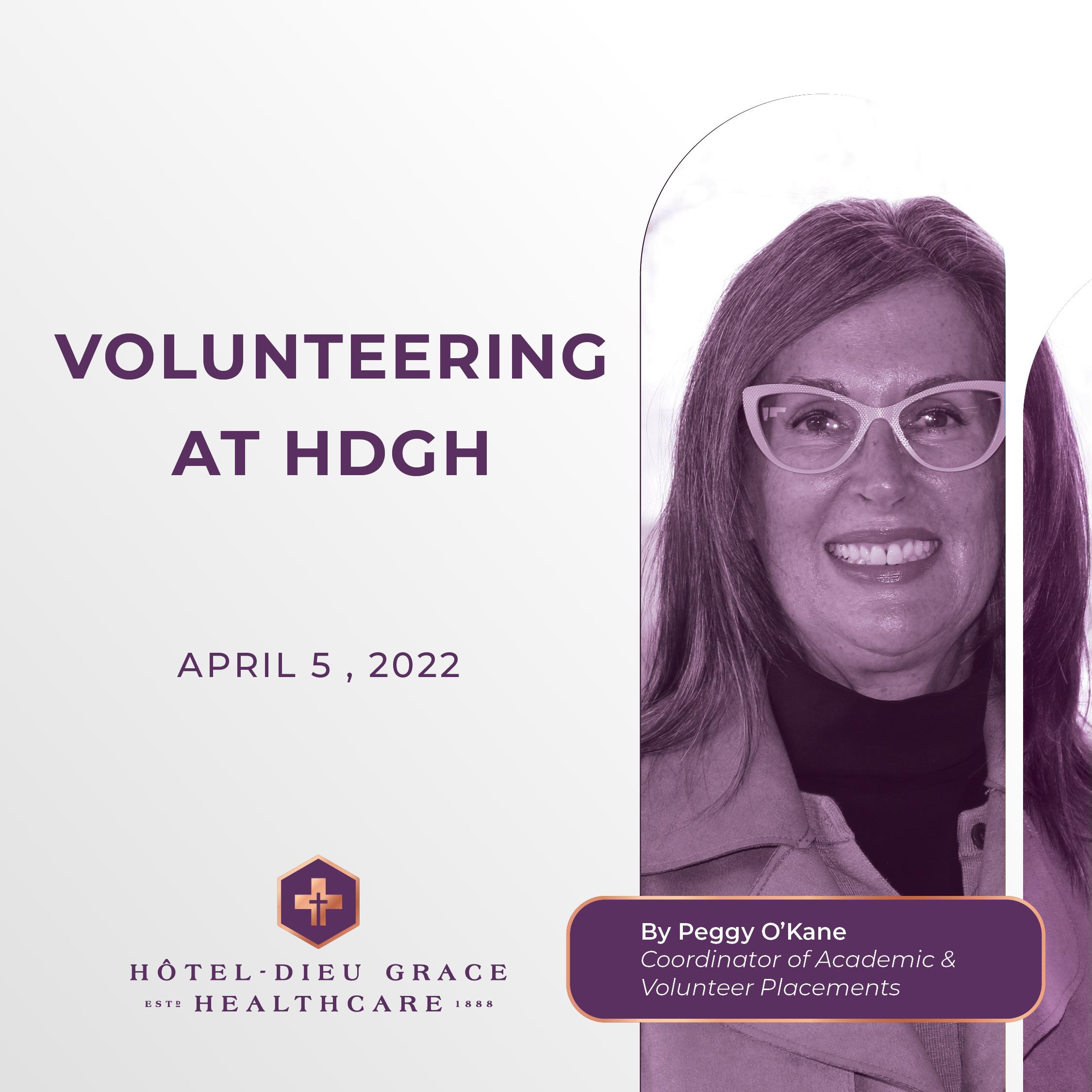

Picture of Peggy O'Kane with the Blogpost Title

Peggy O'Kane

This month, we celebrate the impactful roles of our nation's volunteers during National Volunteer Appreciation Week, April 24 through the 30th. This is the perfect opportunity to write about volunteering at Hôtel-Dieu Grace Healthcare. While COVID protocols have required us to pause on most volunteer opportunities, we have recently begun to welcome our volunteers back onsite, making this the perfect time to highlight some of our volunteer opportunities.


For folks in the Windsor-Essex area looking for volunteer experience, we have several options:

  • As a member of our Hospital or Foundation Board of Directors
  • Fundraising Event Volunteers
  • As a member of our Patient & Family Advisory Councils (PFAC)
  • As a member of our Youth Advisory Council (YAC) or Youth in Partnership (YIP)
  • Patient and Client Assistants
  • Spiritual Care
  • Coffee Bars


COFFEE BARS

Volunteering at our coffee bars is a perfect opportunity for students looking to get their community service hours or for new Canadians and retirees looking to connect within our community.


Recently we have welcomed volunteers back through a phased approach. We started with the Emara Coffee Bar and soon hope to have enough volunteers to open the Tayfour Coffee Bar. Our Coffee Bars operate during the off hours of our cafeterias, making a cup of joe or sweet treat extra accessible for our patients, staff, physicians and Designated Care Partners. Our coffee bars volunteers are a warm welcome to all their customers and the commitment is just one 4 hour shift per week.


To become a coffee bar volunteer or learn more click here.


HDGH PATIENT and FAMILY ADVISORY COUNCILS (PFAC)

PFAC PosterThe patient voice is at the centre of everything we do at HDGH. Established in 2015, PFAC is an advisory committee to the Executive Leadership Team of our hospital. This also included a Mental Health and Addictions Patient Advisory Council, a group of more than 10 individuals who share observations, offer advice and provide input on Mental Health and Addictions care provided by HDGH. These groups are important resources to the organization and are involved in offering ideas on the best way to move forward with changes that affect the patient experience.


If you are a former patient, loved-one of a patient, or have ideas on how to improve local healthcare service delivery, this is the volunteer opportunity for you!


HDGH FOUNDATION EVENTS AND FUNDRAISING COMMITTEES

Being a volunteer at a fundraising event is a great way to get involved in the community, meet new people and give back to healthcare by way of our HDGH Foundation. Whether it is by taking part in a committee or being an event day volunteer, we are always looking for creative and outgoing volunteers of all ages to join the fun.
Volunteer for an Event


HDGH AND FOUNDATION BOARD OF DIRECTORS

The Hôtel-Dieu Grace Board of Directors and standing committees are responsible for providing strategic leadership and direction to the Executive Leadership Team. This dedicated group of volunteers from the community brings a wide range of skills and experience. They are committed to ensuring that HDGH is making Windsor and Essex a healthier community and living out its Mission every day.


The Foundation Board is responsible to oversee the activities of the Foundation, and administering funds entrusted to them, ensuring that it is done ethically and transparently.

Be sure to watch the Hospital’s and Foundation’s social media channels for application information. 


THANK YOU HDGH VOLUNTEERS

I want to take this opportunity to acknowledge the resiliency of our HDGH volunteers. The pause on volunteers during the pandemic has been a challenge for everyone. Through phone calls, emails and messages, we continue to experience your eagerness to return to volunteer, signifying your tremendous dedication to our hospital, and ultimately, the health of our community. We cannot wait to see your smiling faces again soon and many new faces as well, as a Spiritual Care Volunteer, a Pet Visitation Volunteer or as one of our many other patient and client assistant volunteers. Thank you to all for hanging in there. Our regular volunteer updates will continue via email and on our webpage www.hdgh.org/volunteers.


About the author Peggy O’Kane
Coordinator, Volunteer & Academic Placements
Peggy.OKane@hdgh.org

Picture of Peggy O'Kane 

I have been involved with volunteers at HDGH for over 15 years in various roles starting as a volunteer myself in the Human Resources department. While helping there in HR, I quickly learned that HDGH was a community I would like to be a part of long-term. A few months later, I was thankful and excited to join the Volunteer Services department as an Administrative Assistant.


These days, I enjoy extremely rewarding work by engaging with people of all ages and in all stages of their careers, education and life. In addition to my Coordinator role, I am also the staff liaison for the HDGH Youth Advisory Council (YAC), a group that connect through youth-led initiatives to improve the health of our community through mental health education through social media, education events, and volunteering. This group gives me hope for a future where our community continues to grow stronger together.


I would be remiss to not take the opportunity to mention two impactful annual events hosted by YAC - Wellness Through Grace and the Photovoice Project. Follow them on Instagram (@hdghyac) for further updates.


Throughout all this time, while learning from and working with the diverse population of volunteers who have come through our doors, I have seen firsthand how volunteering connects people, ideas and actions and I’ve witnessed the creation of multiple unforgettable and important connections. As we continue to work collectively with volunteers, we all have something to give and something to receive. Volunteers give their time, talent and passions which transform into unique gifts that make a difference in our community. These are the reasons we need to celebrate volunteers here and everywhere during this National Volunteer Week.

'>

New Blog, New Voices, Same Trusted Hospital

Apr 1, 2022 | Mental Health, Leadership, Research and Innovation, Community and Partnerships, Patient Stories, Faces of HDGH, Road to Recovery – Restorative Rehabilitative Care, Palliative Care, Spirituality, Heritage


Welcome image

welcome image

Welcome Readers. Our HDGH Team has always loved sharing stories with our community. Our Blog is just one of the many creative ways to do that with you. It has become a popular corner of our website where everyone is welcome to not only learn ABOUT our hospital, but also FROM the talented healthcare experts and professional voices we are proud to call our HDGH People. Our blog will be home to sharing expertise through varying healthcare-related topics from interviews, experience, patient stories, daily topics on how to stay healthy, and more.


You may have also noticed a new name to the HDGH Blog. “Maison Dieu Health” is a nod to our HDGH Heritage, honouring our French-Canadian five founding sisters of the Religious Hospitallers of St. Joseph’s (RHSJ) who with love, perseverance, faith and persistence travelled from Montreal over 135 years ago to establish Windsor’s first hospital – Hôtel-Dieu of St. Joseph.

You can think of Maison Dieu Health as your refuge for wellness-related resources, all accessible “under one roof” through the many voices of our HDGH staff and community.


With that, welcome to Maison Dieu Health.